
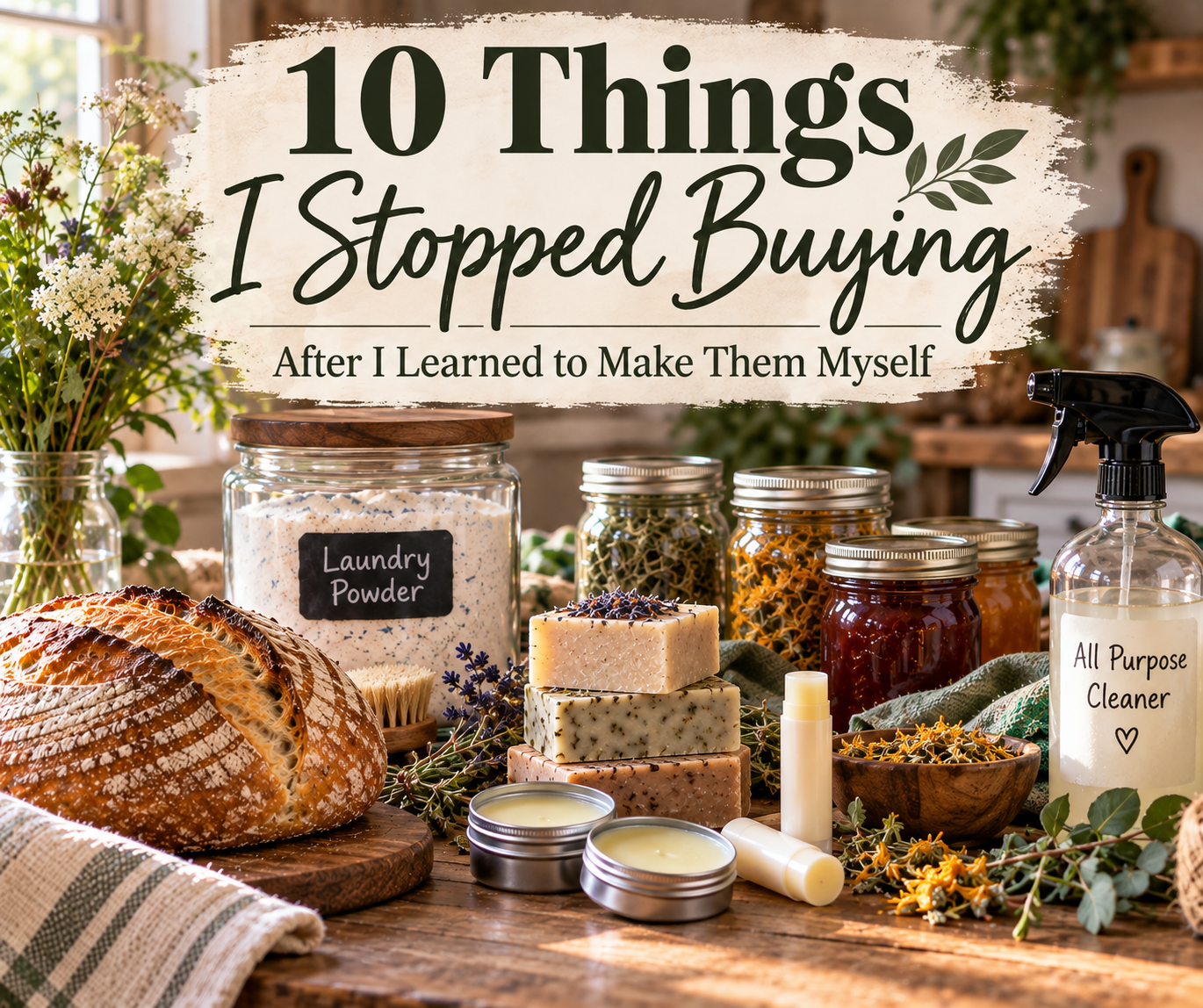
There was a time when I never really thought twice about tossing laundry detergent, bread, deodorant, or household cleaners into my shopping cart. If we needed it, I bought it.
But the more I started learning about homesteading and making things from scratch, the more I began asking a simple question:
Could I make this myself?
I didn’t change everything overnight. I started with one thing, then another. Some swaps saved money. Some helped me cut down on unnecessary packaging and ingredients. And some were simply satisfying because I knew exactly what went into the things I was using in my home.
Here are 10 things I now love making instead of buying.
1. Bread
Bread was one of the best places for me to start.
Once you get comfortable working with dough, you realize how many things you can make with a handful of basic ingredients. And sourdough takes that even further.
A healthy sourdough starter can become bread, rolls, pizza crust, pancakes, crackers, and so much more.
Starting your own starter can feel intimidating, though—especially when you’re trying to figure out whether it’s actually alive.
That’s one reason I love dehydrated sourdough starter. You can reactivate an established starter at home instead of beginning completely from scratch.
Want to start baking your own sourdough? You can find our dehydrated sourdough starter right here at Lettuce Live Living.
2. Laundry Detergent
Laundry products were another thing I started looking at differently.
Instead of automatically buying another giant plastic container every time we ran out, I learned how simple a basic powdered laundry formula could be.
Making it myself also means I get to decide exactly what I put into it.
And once you have the basic ingredients on hand, making another batch takes very little time.
3. Dishwasher Detergent
This one surprised me.
Dishwasher detergent seems like something that has to come from the store until you start learning what the individual ingredients actually do.
Simple ingredients such as washing soda and citric acid can play different roles in cleaning dishes and dealing with minerals in water.
It’s also incredibly convenient to mix up another batch when you’re running low instead of realizing after dinner that you’re completely out.
4. Bar Soap
Making soap was one of those homesteading skills that initially seemed complicated.
Lye sounded intimidating. Measuring everything correctly mattered. And learning about trace, curing time, oils, and additives definitely took some practice.
But once I learned the process, I loved it.
Different oils bring different qualities to soap. Coconut oil, olive oil, and tallow can all serve different purposes, and ingredients such as charcoal or botanicals let you experiment with your own formulations.
There’s something incredibly satisfying about seeing a row of bars curing and knowing you made them yourself.
Important: Soapmaking with sodium hydroxide requires accurate measurements, proper protective equipment, ventilation, and a tested soap formulation. It isn’t a recipe to improvise.
5. Deodorant
Homemade deodorant has definitely involved some experimenting.
And that’s part of homesteading that doesn’t always make it into the pretty pictures online.
Sometimes your first recipe isn’t perfect.
Maybe it’s too oily. Maybe it’s too soft. Maybe you realize you’d like a completely different consistency.
But that’s also the advantage of making something yourself. You can adjust it until you find a formula that works for you instead of being stuck with whatever a manufacturer decided to put in a container.
6. Lip Balm
Lip balm is one of my favorite examples of something that looks complicated but can actually be surprisingly simple.
A basic balm can be made using oils, butters, and waxes in different proportions.
Once you understand the basic formula, you can adjust the firmness and texture until you find what you like.
And those same ingredients can often be used for other homemade products, which brings me to…
7. Lotion Bars
I love products that don’t require a dozen different ingredients.
Solid lotion bars are convenient, compact, and a great way to use some of the same basic ingredients you may already have for other homemade body products.
Instead of having cabinets filled with ingredients that only serve one purpose, I try to choose versatile staples whenever I can.
That’s one of my favorite parts of building a more self-sufficient home.
8. Household Cleaners
You don’t necessarily need a different brightly colored bottle for every surface in your house.
Learning what basic cleaning ingredients actually do changed the way I shop.
Instead of asking, “Which cleaner do I need to buy?” I started asking, “What am I actually trying to clean?”
That mindset makes it much easier to simplify your cleaning cabinet.
And simpler doesn’t have to mean ineffective.
9. Food Preserves
Jam, apple butter, canned vegetables, dried herbs—the list keeps growing.
Food preservation is one of the homesteading skills I think is especially worth learning because it connects you directly to the seasons.
Blueberries don’t have to disappear when blueberry season ends.
Apples can become apple butter.
Herbs can be dried.
Garden vegetables can be preserved.
Learning safe food-preservation methods lets you enjoy some of what you grow, forage, or buy locally long after the season has passed.
For canning, I always recommend following a current, tested recipe from a trusted food-preservation source rather than experimenting with processing times or ingredient ratios.
10. Things I Haven’t Even Thought of Yet
This might actually be my favorite one.
Because once you start making things yourself, something changes.
You begin looking at everyday products differently.
Instead of automatically thinking:
“I need to buy that.”
You start thinking:
“I wonder if I can make that.”
Sometimes the answer is no.
Sometimes buying something makes much more sense.
But other times you discover a skill you’ll use for the rest of your life.
You Don’t Have to Change Everything at Once
I think this is one of the most important things to remember.
Living more naturally or becoming more self-sufficient doesn’t mean throwing away everything in your house tomorrow and replacing it with homemade versions.
That would be expensive, wasteful, and overwhelming.
Start with one thing.
When your laundry detergent runs out, learn about making your own.
When you’re ready to try sourdough, learn how to care for a starter.
Plant one herb.
Make one loaf of bread.
Learn one preservation method.
Then keep building.
That’s really what Lettuce Live Living is about.
Not perfection.
Not doing everything the old-fashioned way just because you can.
It’s about learning useful skills, understanding what goes into the things we use every day, getting closer to where our food and products come from, and becoming a little more self-sufficient along the way.
One homemade swap at a time.
Leave a Reply