
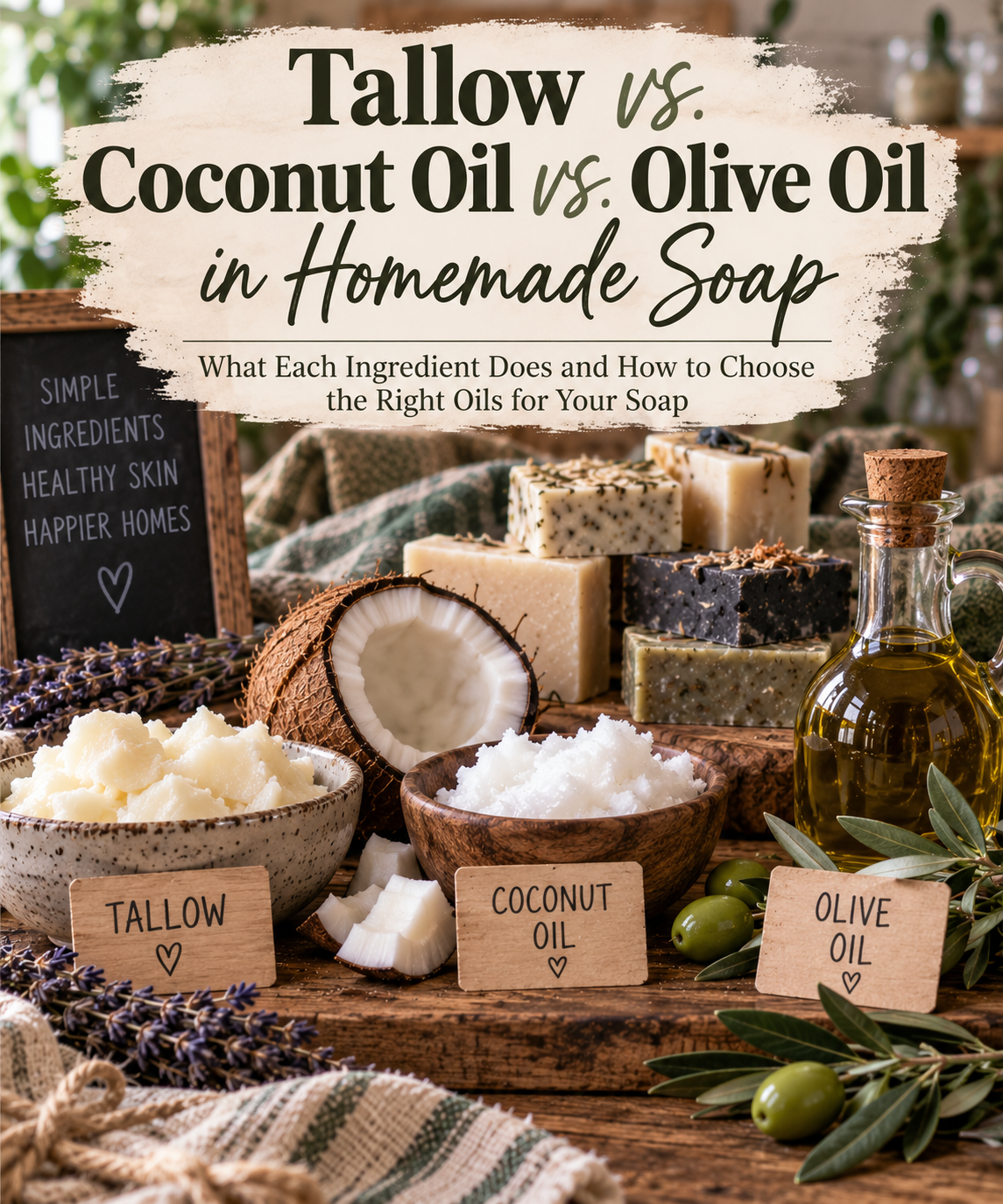
When I first started making homemade soap, I thought oil was oil.
If a recipe called for olive oil, coconut oil, or tallow, I assumed they were basically interchangeable.
They’re definitely not.
One of the most interesting things I’ve learned about soapmaking is that each fat brings something different to the finished bar. Some help create a hard, long-lasting bar. Some contribute to bubbly lather. Others produce a milder, creamier soap.
Once you understand what each ingredient does, soap recipes start making a lot more sense.
Three of the ingredients you’ll see again and again in traditional homemade soap are beef tallow, coconut oil, and olive oil.
Here’s how they compare.
First: Why Does the Type of Oil Matter?
When you make traditional bar soap, fats or oils are combined with sodium hydroxide—commonly called lye.
This starts a chemical reaction called saponification.
During saponification, the fats and sodium hydroxide react to form soap and glycerin.
But different fats contain different combinations of fatty acids. That’s one of the reasons a soap made primarily with olive oil behaves differently from one made with a large amount of coconut oil.
The oils you choose can affect things like:
- Bar hardness
- Lather
- Bubbles
- Creaminess
- Cleansing ability
- Longevity of the bar
- How the soap feels during use
That’s why I like combining oils instead of expecting one ingredient to do everything.
Beef Tallow in Homemade Soap
Tallow is rendered animal fat, most commonly from beef.
It has been used in traditional soapmaking for generations, and there’s a reason it continues to be popular with soapmakers today.
What Tallow Adds to Soap
Tallow is especially useful for creating a firm, durable bar of soap with a creamy lather.
A properly formulated tallow soap tends to hold its shape well and doesn’t disappear in the shower as quickly as some softer bars.
It can contribute:
Hardness: ★★★★★
Creamy lather: ★★★★★
Big bubbles: ★★☆☆☆
Bar longevity: ★★★★★
One of my favorite things about tallow is that it fits naturally into the idea of using resources rather than wasting them.
When properly rendered and incorporated into a balanced recipe, it makes a beautiful traditional soap.
Does Tallow Soap Smell Like Beef?
Properly rendered tallow shouldn’t leave your finished soap smelling like a steak.
Rendering and cleaning the fat properly is important, though. Poorly rendered tallow may retain odors or impurities that you don’t want in your soap.
Coconut Oil in Homemade Soap
If tallow helps build the structure of the bar, coconut oil is one of the ingredients that can bring the bubbles.
Coconut oil is popular in soapmaking because it produces a hard bar with strong cleansing properties and fluffy, bubbly lather.
What Coconut Oil Adds
Hardness: ★★★★☆
Creamy lather: ★★★☆☆
Big bubbles: ★★★★★
Cleansing: ★★★★★
That sounds perfect—but there’s a catch.
More coconut oil isn’t necessarily better.
A soap containing a high percentage of coconut oil can be very cleansing, which can also make the bar feel drying for some people.
That’s one reason coconut oil is frequently combined with milder oils and fats rather than simply making up the entire recipe.
The right amount depends on the complete formulation and the intended use of the soap.
Olive Oil in Homemade Soap
Olive oil behaves very differently from coconut oil.
Rather than being known for huge bubbles and aggressive cleansing, olive oil is valued for producing a milder soap with a smooth, conditioning feel.
What Olive Oil Adds
Hardness: ★★★☆☆*
Creamy lather: ★★★★☆
Big bubbles: ★☆☆☆☆
Mildness: ★★★★★
Olive-oil-heavy soaps can initially be relatively soft and often benefit from a long cure. Over time, they can become very hard and long-lasting bars.
Olive oil soap doesn’t normally create the giant fluffy bubbles people associate with coconut-oil-heavy soap.
Its lather tends to be more subtle and creamy.
And that’s okay.
Not every ingredient needs to create bubbles.
So Which Oil Is Best?
This is where soapmaking gets interesting.
There isn’t necessarily a winner.
I don’t look at it as:
Tallow vs. coconut oil vs. olive oil.
I look at it as:
What can each one contribute to the same bar?
Tallow can provide structure, hardness, longevity, and creamy lather.
Coconut oil can provide cleansing power, hardness, and bubbles.
Olive oil can help create a milder, more conditioning bar.
Put them together in a thoughtfully formulated recipe and you can take advantage of characteristics from all three.
Quick Comparison
| Ingredient | Hardness | Bubbles | Creaminess | Cleansing | Best Known For |
|---|---|---|---|---|---|
| Beef Tallow | High | Low–Moderate | High | Moderate | Hard, long-lasting bars |
| Coconut Oil | High | High | Moderate | High | Big bubbles and cleansing |
| Olive Oil | Develops with cure | Low | High | Mild | Gentle, conditioning soap |
Can You Substitute One Oil for Another?
This is probably the most important thing to know if you’re new to soapmaking:
Don’t simply swap oils in a soap recipe while keeping the same amount of lye.
Different fats require different amounts of sodium hydroxide for saponification.
So if a recipe calls for tallow and you decide to replace it with olive oil, for example, the required amount of sodium hydroxide may change.
Any time you change the type or quantity of oils in a soap formulation, the recipe needs to be recalculated using reliable saponification values or a reputable soap calculator.
Soapmaking isn’t the place to eyeball measurements.
Why I Like Simple Soap Recipes
Once I started learning more about homemade products, I realized that I didn’t necessarily need a huge collection of specialty ingredients.
I’d rather understand a handful of ingredients really well.
Tallow.
Coconut oil.
Olive oil.
Herbs.
Charcoal.
Simple ingredients can give you an incredible amount of flexibility once you understand what each one contributes.
You can then formulate different bars depending on what you’re trying to accomplish instead of adding ingredients simply because they sound good on a label.
What About Herbs, Charcoal, and Other Additives?
This is where soapmaking gets really fun.
Once you have a well-formulated base recipe, you can experiment with appropriate additives.
I’ve enjoyed working with ingredients such as homemade charcoal, lavender, and white pine needles.
But additives shouldn’t replace a properly formulated soap base.
Think of your oils as the foundation of the house.
The botanicals, charcoal, clays, and other additions are everything you add afterward.
You need a solid foundation first.
A Quick Note About “Natural” Soap
I think it’s also important to be transparent about what homemade soap actually is.
Traditional cold-process soap requires an alkali such as sodium hydroxide.
That sometimes surprises people who are trying to make more natural products at home.
But sodium hydroxide is what allows the chemical reaction of saponification to occur. When a properly calculated soap recipe fully saponifies and cures, you’re no longer looking at a bowl of oils and lye—you’ve created soap.
That doesn’t mean lye itself is harmless.
Sodium hydroxide is highly caustic and can cause serious chemical burns.
Always use proper protective equipment, accurate measurements, appropriate containers, good ventilation, and established soapmaking safety procedures when working with it.
The Biggest Thing I’ve Learned About Making Soap
Homemade soap isn’t really about finding one magical ingredient.
It’s about balance.
You start understanding why one oil makes the bar harder, why another creates more bubbles, and why another changes the feel of the lather.
And suddenly you’re not just following a recipe anymore.
You’re learning a skill.
That’s one of my favorite parts of homesteading.
You don’t have to learn everything at once. You just keep learning what each ingredient does, why people used it, and how you can use that knowledge in your own home.
One skill—and one bar of soap—at a time.