
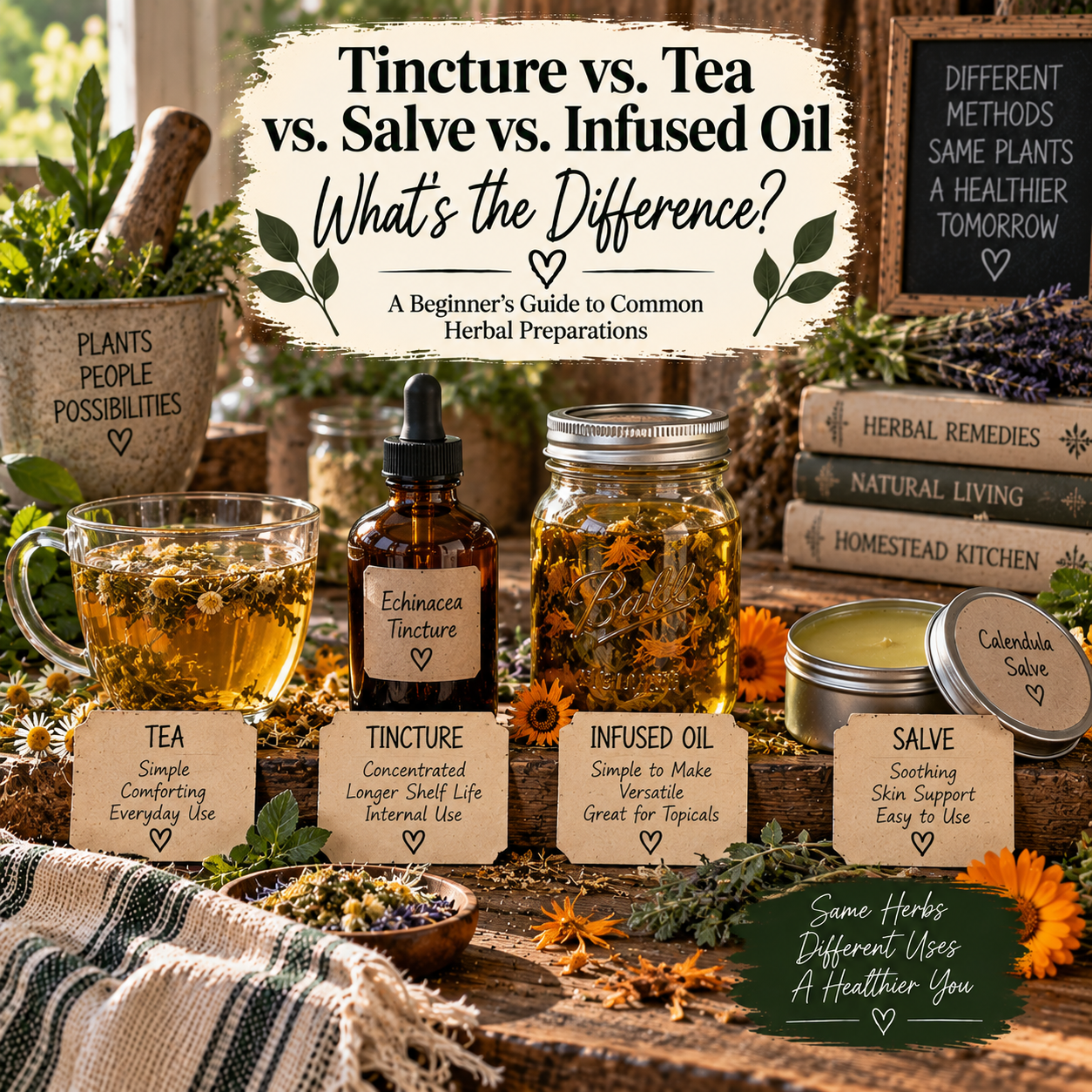
When I first started learning about herbs, one of the most confusing things wasn’t the plants.
It was figuring out what I was supposed to do with them.
Should you make tea?
Put them in oil?
Make a salve?
What’s a tincture?
Here’s the simple version.
Herbal Tea
Herbal tea uses water to extract compounds from plant material.
You generally pour hot water over the appropriate plant material, steep it and strain it.
Different herbs and plant parts require different preparation methods, so don’t assume every plant should be prepared exactly like peppermint tea.
Herbal Tincture
A tincture is a concentrated herbal extract traditionally made using alcohol as the solvent.
Alcohol can extract compounds that water may not extract as effectively and also gives properly prepared tinctures a relatively long shelf life.
Tinctures require more precision than simply filling a jar with herbs and alcohol. The plant, whether it’s fresh or dried, alcohol concentration and herb-to-solvent ratio all matter.
Herbal Infused Oil
An herbal infused oil is made by allowing appropriate plant material to infuse into a carrier oil.
Examples of carrier oils include olive oil, sunflower oil and jojoba.
These preparations are typically used externally or as ingredients in topical products, depending on the herb and oil.
Herbal Salve
A salve takes an infused oil one step further.
The herbal oil is combined with wax—often beeswax—to produce a semi-solid product that is easier to apply to skin.
Which Should You Make?
Think about your intended use.
Want a warm drink? Tea.
Want an alcohol-based extract? Tincture.
Want a topical liquid oil? Infused oil.
Want something you can rub onto skin without it running everywhere? Salve.
One Herb Can Become Several Preparations
That’s what makes herbalism so interesting.
Calendula, for example, can be dried, infused into oil and incorporated into a salve.
But preparation doesn’t automatically make an herb safe or effective for every purpose.
Research the individual plant before deciding how to use it.
Herbal Safety
Always identify herbs correctly and check contraindications and medication interactions. External preparations can also cause allergic reactions, so discontinue use if irritation occurs.
Learning herbalism becomes much easier once you understand the preparations.
The plant is only half the story. How you prepare it matters too.
Leave a Reply